

How to Choose a Pickleball Court Surface: Where Interlocking Tiles and Acrylic Rolls Each Fit
Pickleball keeps adding courts. USA Pickleball’s 2025 Annual Growth Report, published on 30 January 2026, records its court database growing from 68,458 courts in 2024 to 82,613 courts in 2025, across 18,258 locations. The commercial database CourtSource.us estimates that the United States still needs 25,000 to 40,000 additional courts by 2028 — between 800millionand800millionand1.6 billion of construction. The more courts get built, the less the surface is a formality.
Outdoor Courts and Conversions: Modular Interlocking Tiles
These tiles need no adhesive and no curing, and they go straight onto an existing asphalt or concrete base — which puts idle tennis courts and paved schoolyards back to work. Drainage runs through the tile body, so standing water does not have to evaporate before play resumes. UV stabilizers in the compound and a rating down to −30°C support an outdoor service life of ten years or more, and a damaged tile is replaced on its own rather than by resurfacing the whole court. An outdoor court costs roughly 35,000–35,000–75,000 to build, and public projects carry fixed procurement budgets and tight schedules — which is exactly where this option sits.
Indoor and Event Venues: Acrylic Roll Flooring
Rolls take a different route. A PVC base carries a modified-acrylic wear surface, supplied in a uniform 1.8 m width at a standard 3.0 mm, with a 2.0 mm economy option, and cut and seamed to the court on site — fewer seams, and a more continuous playing field. Each layer does one job: an all-weather UV-resistant acrylic surface for weathering, a modified-acrylic intermediate layer for speed regulation and rebound, a fiberglass layer against thermal expansion and contraction, and a waterproof, moisture-resistant base layer that allows installation over basements and open-air sites alike. The four surface patterns divide the work too: the emery style targets all-weather indoor and outdoor use, the sand-textured styles lean indoor and semi-outdoor, and the 360 Customized style supports full-court color schemes, zone colors and printed brand graphics. Rolls can be rolled back up, so temporary tournaments can assemble and dismantle them repeatedly, and standard court lines can be applied at the factory. Warranty: three years indoor, two years outdoor.
Two Routes: One for Speed, One for Stability
Interlocking tiles answer speed and weather: conversions over an existing base, short schedules and procurement-constrained budgets suit them. Rolls answer consistency: a continuous surface, even ball speed and friction, and customizable colors and lines suit commercial clubs and event venues. The two suit different conditions, so judging them by court type — rather than pricing them against each other on a single quote sheet — is what actually helps.
What buyers should take from this: fix the route by court type first, then compare parameters. Outdoor conversions should be judged on drainage, UV and freeze data, plus a spare-parts commitment for single-tile replacement. Indoor projects should be judged on wet and dry friction coefficients, shock absorption and surface abrasion data, with warranty terms that separate indoor from outdoor. Either way, ask for technical data sheets and batch test reports carrying test dates — not just a certificate.
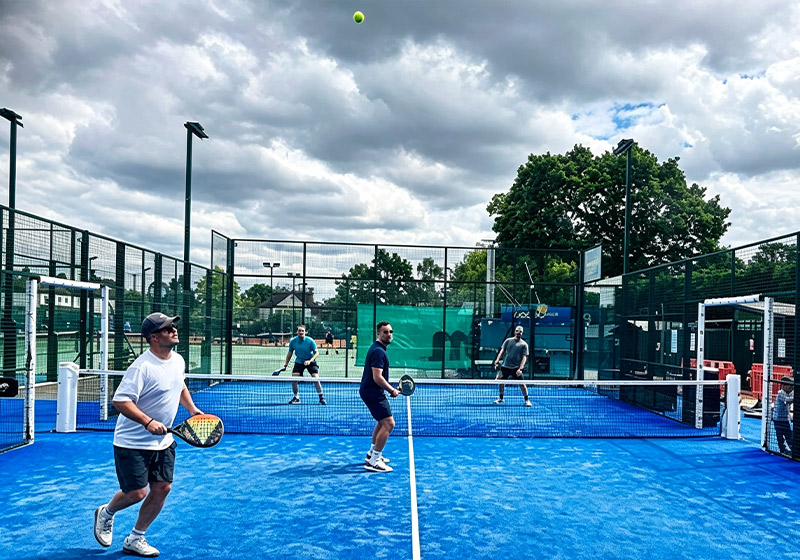
Padel Adds Nearly 8,000 Courts in a Year — Hard Surfaces Start Eating Into Turf’s Market Share
Playtomic and PwC Strategy& publish an annual global padel report, and the 2026 edition is solid: roughly 58,000 courts worldwide, over 20,000 clubs, around 19 million active players. Nearly 8,000 new courts were added in 2025 alone — a 16% year-on-year jump. Industry projections put the total at close to 91,000 courts by 2028.
For the flooring industry, the total number isn’t the real story. The structural shift is.
The first shift: growth is decentralizing. Spain still leads in absolute numbers, but the new courts are increasingly in Indonesia, Brazil, the United States, Australia, India, and Poland. These markets share a common profile — rising disposable income, almost zero existing court stock, and no domestic manufacturing base. Whoever gets in first builds channel stickiness.
The US makes the point vividly: fewer than 800 courts nationwide, but roughly half a million active players. That ratio isn’t “future potential”— it’s”undersupply right now.”
The second shift: surface materials are diverging. Traditionally, sand-filled artificial turf has been the default for padel courts, and the International Padel Federation (FIP) still endorses it. But real-world use reveals friction points — sand needs periodic replenishment, maintenance is heavy, heat absorption under direct sun is brutal, and drainage after heavy rain is slow. In hot-climate markets, project owners are increasingly looking at alternatives.
Poured acrylic is one option — clean appearance, seamless finish. But in tropical conditions it cracks under thermal cycling and requires long curing times.
PP interlocking tiles are the third option, and the one gaining ground fastest. They drain instantly, resist UV degradation, and individual damaged tiles can be swapped without ripping up the whole court. Adoption is especially strong in the UAE, Saudi Arabia, and Southeast Asia — markets where heat and rain are the primary surface killers.
Atelling data point: Mondo was named FIP’s Official Global Turf Partner in April 2024. Note the word — “Turf.” There is currently no equivalent official designation for hard-surface padel courts. That means the hard-surface segment hasn’t been locked down by any dominant brand yet. The window for differentiation is still open.
One more detail that gets overlooked: color. Blue and black now account for nearly 70% of new court installations globally, while green continues to shed share. This isn’t just an aesthetic footnote — manufacturers serving the padel market need to maintain consistent inventory depth in blue and black pigment formulations, especially for UV-stabilized outdoor grades.
Quick math: 8,000 new courts per year, each roughly 200 square meters including playing area and run-off zones, puts annual flooring demand from new padel construction at around 1.6 million square meters. That’s not Earth-shattering volume, but the growth is steady, the customer quality is high, and hard surfaces are still in the penetration phase. Suppliers who move early have a real shot at building channel inertia before the category consolidates.
OUR FACILITIES
Professional One-Stop Sports Flooring Manufacturer & Global Supplier
Please fill out the form below and we will get back to you as soon as possible.